
المحامي يوسف الخضوري | استشارات قانونية

Legal & Corporate Gateway to the Gulf

Real Estate Legal Services

Explore our comprehensive real estate legal services in Oman. We offer expert legal consultations, contract drafting, and dispute resolution to protect property owners and investors.

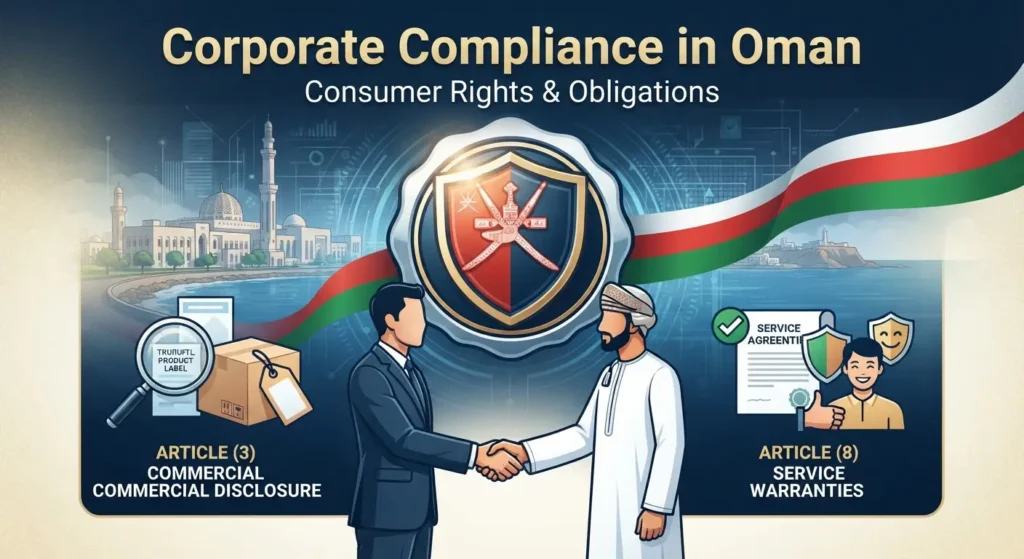
Corporate Compliance and Consumer Rights Infographic in Oman

Corporate Compliance in Oman: Understanding Consumer Rights and Obligations Under Articles (3) and (8) of the Consumer Protection Law

When establishing a business or expanding commercial operations in the Sultanate of Oman, foreign investors and corporate founders must navigate more than just corporate registration laws. Ensuring full compliance with Oman’s consumer protection framework is a critical pillar for long-term business success, brand reputation, and legal security. Promulgated by Royal Decree No. 66/2014, the Omani Consumer Protection Law establishes strict standards of transparency, fair trade, and accountability. For new corporate entities, understanding core provisions—specifically Articles (3) and (8)—is essential to avoid severe legal penalties and build consumer trust from day one. 1. Transparency and Commercial Disclosure: Article (3) Article (3) of the Consumer Protection Law forms the bedrock of fair commercial dealings in the Omani market. It emphasizes the consumer’s fundamental right to accurate information regarding any goods or services offered by a commercial enterprise. Core Legal Principle: Suppliers, business owners, and corporate entities are legally obligated to provide clear, truthful, and non-misleading information about their products and services. This includes accurate labeling, transparent pricing, and clear descriptions of service deliverables. Impact on Foreign Investors: For companies setting up operations in Oman—whether in retail, e-commerce, or service sectors—marketing materials, contracts, and digital platforms must precisely reflect the nature of goods or services. Just as businesses must carefully manage their commercial headquarters and lease agreements in compliance with updated property rules Comprehensive Guide to Royal Decree No. 12/2025: Reforming Omani Rental Regulations…), misleading advertisements or hidden conditions directly breach Article (3), exposing the company to severe administrative fines and legal liabilities. 2. Service Warranties and Corporate Accountability: Article (8) While Article (3) focuses on pre-contractual transparency, Article (8) governs post-sale accountability and the performance guarantees that businesses must uphold. Core Legal Principle: A provider or supplier is mandated to deliver services or execute works properly, adhering to professional standards. Furthermore, Article (8) requires businesses to guarantee the services they provide within a specified timeframe appropriate to the nature of the service. If a defect is found or if the service fails to meet the agreed-upon standard, the provider is legally bound to rectify the flaw, repeat the service properly, or refund the consumer accordingly. Impact on Foreign Investors: Corporate service providers, contractors, and B2C businesses must implement robust internal quality control and customer service protocols. Establishing clear, written service level agreements (SLAs) and warranty policies aligned with Article (8)—much like understanding property obligations and liabilities Tenant Liabilities and Property Management Under Article (176) of Omani Law)…*—protects the business from legal liabilities and demonstrates a strong commitment to Omani regulatory standards. Conclusion Navigating the legal landscape during corporate setup in Oman requires a comprehensive approach to compliance. Adhering strictly to Articles (3) and (8) of the Consumer Protection Law safeguards foreign investments from unexpected legal disputes, enhances consumer confidence, and ensures seamless integration into Oman’s thriving economic ecosystem. For international investors, partnering with local legal experts ensures that corporate compliance frameworks—from drafting standard terms of service to consumer dispute resolution—are fully aligned with Omani legislation.

Corporate Compliance in Oman: Understanding Consumer Rights and Obligations Under Articles (3) and (8) of the Consumer Protection Law Read More »

Comprehensive Guide to Royal Decree No. 12/2025: Reforming Omani Rental Regulations and Executive Powers for Property Owners

Introduction: A New Era for Real Estate and Property Management in Oman The Omani real estate landscape witnessed a monumental legislative shift with the promulgation of Royal Decree No. 12/2025, issued by His Majesty Sultan Haitham bin Tarik on January 7, 2025 (published in the Official Gazette No. 1579 on January 13, 2025). This landmark decree amends critical provisions of the foundational Royal Decree No. 6/89, which governs the relationship between landlords and tenants of residential, commercial, and industrial properties, alongside the registration of corresponding lease agreements. For property owners, investors, and professional managers, understanding these legal updates is no longer optional—it is a core requirement for asset protection and risk mitigation. Under this reform, the legal mechanisms for dispute resolution, lease enforcement, and eviction have been entirely overhauled to accelerate justice, enhance contractual security, and streamline property operations. In this comprehensive analysis, we explore the core provisions of Royal Decree No. 12/2025, its impact on property management, and how these changes fortify the rights of landlords across the Sultanate. 1. Legislative Overview: The Foundation of Royal Decree No. 12/2025 Royal Decree No. 12/2025 was enacted following high-level legislative reviews, taking into account: The Basic Statute of the State. The foundational landlord-tenant framework under Royal Decree No. 6/89. The Civil and Commercial Procedures Law issued via Royal Decree No. 29/2002. The Law on Simplifying Litigation Procedures for Certain Disputes under Royal Decree No. 125/2020. The Governorates System issued via Royal Decree No. 36/2022. Crucially, Article Four of the decree stipulated that its provisions enter into force after six months from the date of its issuance, ensuring a structured transition period for the Omani judicial and administrative ecosystem. 2. Key Structural Amendments Introduced by the Decree A. Terminological Modernization Article One of the amendments modernizes the legal terminology to reflect contemporary real estate practices. The phrase “leased shop” (Al-Mahal Al-Moa’jar) has been universally replaced with “leased property” (Al-Aqar Al-Moa’jar) across all regulatory texts of Royal Decree No. 6/89. This ensures that the framework expansively covers modern multi-unit residential blocks, commercial complexes, and industrial warehouses alike. B. Establishment of the Rent Dispute Settlement Committees Perhaps the most significant structural reform is the total replacement of traditional court pathways for rental disputes. Article One and Article Two substitute the terms “Court” and “Competent Court” with a specialized administrative-judicial body: The Rent Dispute Settlement Committee (Lajnat Al-Fasl Fi Al-Munaza’at Al-Ijaariyah). According to the newly integrated Article (15): A specialized committee (or committees) is established within every Governorate. These committees hold exclusive jurisdiction to adjudicate all disputes arising from the rental decree, explicitly including eviction matters. Chaired by a First Instance Court judge nominated by the Supreme Judicial Council, each committee includes two administrative members representing the governorate and municipality, ensuring a streamlined, expert-driven adjudication process. 3. The Power of Executive Instruments: Lease Agreements as Executive Writs For landlords, one of the most powerful and revolutionary provisions introduced by Royal Decree No. 12/2025 is embedded in Article (16). Under Article 16, a registered lease agreement now holds the force of an executive writ (Quwat Al-Sanad Al-Tanfeethi). This means a standard lease contract is no longer treated merely as a civil agreement requiring a lengthy lawsuit in the case of default; rather, it possesses direct executive standing. The Execution Department at the competent Court of First Instance is mandated to affix the executive formula (Al-Sigha Al-Tanfeethiyah) directly onto the lease agreement. If the department delays or refuses, parties have the right to petition the head of the court directly for an expedited order on petition (Amr Ala Aridha) to secure execution. This mechanism drastically reduces the time required to recover unpaid rents or enforce contractual obligations, transforming lease agreements into high-security financial instruments. Property owners seeking to secure their investments can leverage professional guidance detailed under our dedicated Legal Services in Oman for English Speakers framework. 4. Procedural Workflow of the New Rent Dispute Committees To ensure transparency and speed, the newly added provisions (Articles 17 through 33) establish clear procedural steps for the Secretariat of the Rent Dispute Settlement Committee: Filing and Registration: The secretariat receives dispute applications accompanied by supporting documents and proof of fee payment, registering them immediately in dedicated ledgers and providing applicants with official receipts (Article 17). Expedited Briefing: The secretariat prepares concise legal summaries of the application for review by the committee head, reducing procedural bottlenecks. Transition of Legacy Cases: Article Two of the main decree ensures continuity by confirming that ongoing lawsuits filed prior to the implementation date remain under the purview of standard courts until final resolution, while all new claims route directly through the specialized committees. 5. Strategic Implications for Property Management and Owners For investors and real estate owners managing multi-family units or commercial spaces, these legal developments heavily emphasize the need for professional, legally compliant oversight. Managing a building requires navigating rigorous documentation, strict adherence to registration rules, and rapid deployment of executive mechanisms when disputes arise. When looking to optimize asset yields and eliminate the administrative burdens of tenant management, partnering with a specialized provider is essential. Comprehensive operational and legal frameworks for buildings are further explored in our guide on Legal Building Management Services in Oman. By integrating expert oversight with these updated statutory instruments, landlords can secure uninterrupted cash flows and absolute legal compliance. Conclusion Royal Decree No. 12/2025 marks a turning point for the Omani rental market, establishing a balanced, swift, and highly enforceable legal ecosystem. By granting lease agreements executive force and establishing specialized committees in every governorate, the Omani legislature has heavily tilted the scale toward contractual security and investment protection. Whether you are an individual landlord or an international investor expanding your portfolio through structures such as Oman Business Setup & Commercial Arbitration for International Investors, keeping aligned with these statutory provisions ensures your assets remain shielded against default, delay, and procedural friction.

Comprehensive Guide to Royal Decree No. 12/2025: Reforming Omani Rental Regulations and Executive Powers for Property Owners Read More »

Building management and tenant liabilities under Article 176 of Omani law

Tenant Liabilities and Property Management Under Article (176) of Omani Law

Comprehensive Legal Guide: Tenant Liabilities, Property Management, and the Application of Article (176) of the Omani Civil Transactions Law Introduction to Property Management and Rental Regulations in Oman The real estate sector in the Sultanate of Oman is witnessing rapid, structured growth, supported by modern legal frameworks designed to balance the rights and obligations of both landlords and tenants. Effective building management extends far beyond routine maintenance, rent collection, and facility upkeep; it fundamentally encompasses rigorous legal oversight to protect property assets from depreciation, structural damage, and unauthorized alterations. When leasing residential, commercial, or mixed-use properties, landlords entrust substantial assets to tenants. While standard wear and tear are anticipated aspects of any tenancy, intentional or negligent destruction, structural tampering, or failure to restore the premises to its original condition creates severe legal liabilities. Understanding how civil law addresses these violations is critical for property managers, legal consultants, and asset owners striving to maintain optimal property value and enforce strict compliance with lease agreements. For a broader perspective on professional property oversight and specialized asset care, you can review our core resource on Legal Building Management Services in Oman (https://law-yuosif.com/legal-building-management-services). Ensuring that lease documentation addresses these protective measures from day one prevents costly litigation down the line. The Legal Nature of Lease Contracts under Omani Law Under the legal framework of Oman, a lease contract (Ijarah) is a binding bilateral agreement that confers upon the tenant the right to use and exploit the leased property for a specified period in exchange for a designated rent. This relationship is governed by the principles of Sharia jurisprudence and codified provisions within the Omani Civil Transactions Law (Promulgated by Royal Decree No. 29/2002). A lease does not transfer ownership; rather, it transfers temporary possession and utility. Consequently, the tenant assumes a strict fiduciary duty of care. The tenant is obligated to preserve the property, use it strictly according to the agreed-upon purpose, and return it upon the expiration of the lease term in the same condition in which it was received, barring natural wear and tear. Property managers play an indispensable role in safeguarding this lifecycle by conducting thorough move-in and move-out inspections, documenting baseline property conditions, and embedding compliance clauses directly into the tenancy agreements. To explore our specialized analysis of specific legislative articles governing asset protection, you may reference our dedicated study on Article 176 Analysis and General Provisions (https://law-yuosif.com/article-176-general-provisions). Detailed Analysis of Article (176) of the Omani Civil Transactions Law At the heart of tenant liability regarding property damage, destruction, or improper alteration lies Article (176) of the Omani Civil Transactions Law. This statutory provision establishes clear boundaries regarding tenant accountability when a property is impaired, altered, or disrupted beyond normal usage parameters. While exact textual interpretations focus on the preservation of leased assets and restitution for damages, the core legal philosophy of Article (176) dictates that any destruction, structural damage, or functional disruption caused by the tenant’s fault, negligence, or misuse creates a direct legal obligation to indemnify the landlord. Key Legal Pillars of Article (176): Duty of Restitution in Original Condition: The tenant is legally bound to return the real estate unit in the exact state it was handed over, subject only to normal depreciation resulting from regular use. Liability for Unapproved Alterations: If a tenant undertakes unauthorized construction, demolition, drilling, or structural partitioning (often described colloquially as taksir or breaking walls), they are legally liable to restore the premises to its original layout or compensate the landlord for the financial cost of restoration. Compensation for Operational Disruption: If the property’s utility or commercial viability is crippled due to tenant negligence or misuse—rendering it temporarily unrentable—the tenant must cover the consequential damages, including lost rental income during the repair period. For comprehensive insights into how local statutes interact with commercial lease structures, you can cross-reference external standards via the Ministry of Housing and Urban Planning – Oman (https://www.housing.gov.om) for regulatory updates and urban property guidelines. Tenant Obligations vs. Landlord Rights in Building Management Effective building management requires a harmonious balance between enforcing landlord rights and respecting tenant privacy. However, when a tenant crosses the boundary from normal occupancy into negligence or willful destruction, proactive legal intervention is required. Maintenance and Alteration Restrictions Tenants are strictly prohibited from making structural modifications without prior written consent from the property manager or landlord. Unauthorized partitioning, removal of fixtures, or electrical tampering not only violate lease terms but also trigger liabilities under Article (176). If such actions paralyze the functionality of the building’s systems, the tenant absorbs full financial liability for remediation. Handover Protocols and Checkout Inspections A primary safeguard in professional property management is the execution of rigorous exit protocols. When a tenancy concludes, a joint inspection must take place. If structural defects, severe wall damage, broken installations, or infrastructural neglect are discovered, the property manager has the legal right to withhold security deposits and initiate claims for full civil compensation. Consequential Damages and Lost Opportunity Property damage is rarely limited to the physical cost of cement, paint, or wiring. In commercial and residential complexes, damaged units cause vacancy downtime. Omani civil jurisprudence allows landlords to claim compensation for financial losses stemming from the inability to re-lease the property while repairs are underway. Practical Case Studies in Omani Property Management To illustrate the practical application of these legal principles, consider the following real-world scenarios frequently encountered in Omani real estate management: Case Study A: Commercial Warehouse Modification and Destruction A commercial tenant leases a warehouse facility in an industrial zone managed by a professional property firm. Without authorization, the tenant installs heavy internal mezzanine structures by drilling deep into core structural columns and removing security partitions. Upon lease termination, the tenant vacates the premises, leaving compromised structural elements and severe wall fractures. Legal Application: Under the principles reinforced by Article (176), the property management firm initiates a legal claim. The court orders the tenant to bear the total cost of structural engineering repairs, reinforcement materials, and compensation for the months the

Tenant Liabilities and Property Management Under Article (176) of Omani Law Read More »