
المحامي يوسف الخضوري | استشارات قانونية

Legal & Corporate Gateway to the Gulf

Foreign Investor Guide

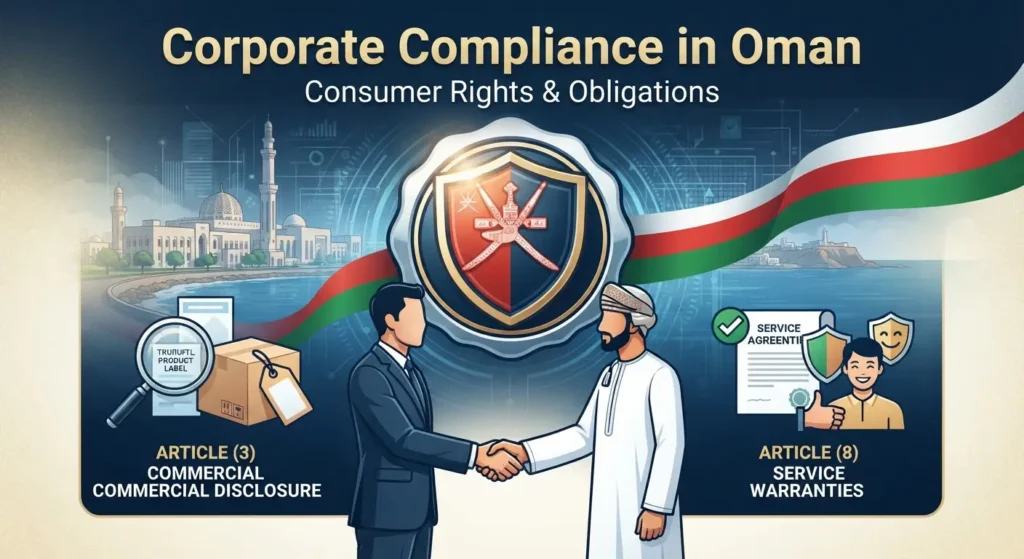
Corporate Compliance and Consumer Rights Infographic in Oman

Corporate Compliance in Oman: Understanding Consumer Rights and Obligations Under Articles (3) and (8) of the Consumer Protection Law

When establishing a business or expanding commercial operations in the Sultanate of Oman, foreign investors and corporate founders must navigate more than just corporate registration laws. Ensuring full compliance with Oman’s consumer protection framework is a critical pillar for long-term business success, brand reputation, and legal security. Promulgated by Royal Decree No. 66/2014, the Omani Consumer Protection Law establishes strict standards of transparency, fair trade, and accountability. For new corporate entities, understanding core provisions—specifically Articles (3) and (8)—is essential to avoid severe legal penalties and build consumer trust from day one. 1. Transparency and Commercial Disclosure: Article (3) Article (3) of the Consumer Protection Law forms the bedrock of fair commercial dealings in the Omani market. It emphasizes the consumer’s fundamental right to accurate information regarding any goods or services offered by a commercial enterprise. Core Legal Principle: Suppliers, business owners, and corporate entities are legally obligated to provide clear, truthful, and non-misleading information about their products and services. This includes accurate labeling, transparent pricing, and clear descriptions of service deliverables. Impact on Foreign Investors: For companies setting up operations in Oman—whether in retail, e-commerce, or service sectors—marketing materials, contracts, and digital platforms must precisely reflect the nature of goods or services. Just as businesses must carefully manage their commercial headquarters and lease agreements in compliance with updated property rules Comprehensive Guide to Royal Decree No. 12/2025: Reforming Omani Rental Regulations…), misleading advertisements or hidden conditions directly breach Article (3), exposing the company to severe administrative fines and legal liabilities. 2. Service Warranties and Corporate Accountability: Article (8) While Article (3) focuses on pre-contractual transparency, Article (8) governs post-sale accountability and the performance guarantees that businesses must uphold. Core Legal Principle: A provider or supplier is mandated to deliver services or execute works properly, adhering to professional standards. Furthermore, Article (8) requires businesses to guarantee the services they provide within a specified timeframe appropriate to the nature of the service. If a defect is found or if the service fails to meet the agreed-upon standard, the provider is legally bound to rectify the flaw, repeat the service properly, or refund the consumer accordingly. Impact on Foreign Investors: Corporate service providers, contractors, and B2C businesses must implement robust internal quality control and customer service protocols. Establishing clear, written service level agreements (SLAs) and warranty policies aligned with Article (8)—much like understanding property obligations and liabilities Tenant Liabilities and Property Management Under Article (176) of Omani Law)…*—protects the business from legal liabilities and demonstrates a strong commitment to Omani regulatory standards. Conclusion Navigating the legal landscape during corporate setup in Oman requires a comprehensive approach to compliance. Adhering strictly to Articles (3) and (8) of the Consumer Protection Law safeguards foreign investments from unexpected legal disputes, enhances consumer confidence, and ensures seamless integration into Oman’s thriving economic ecosystem. For international investors, partnering with local legal experts ensures that corporate compliance frameworks—from drafting standard terms of service to consumer dispute resolution—are fully aligned with Omani legislation.

Corporate Compliance in Oman: Understanding Consumer Rights and Obligations Under Articles (3) and (8) of the Consumer Protection Law Read More »

UAE Contracting and Logistics Setup Guide

UAE Contracting & Logistics Setup: Legal Frameworks & Asset Guide

  The United Arab Emirates (UAE) has firmly established itself as a premier global hub for international entrepreneurs, corporate investors, and business innovators. Among the various thriving economic sectors, construction, heavy contracting, and logistics stand out as the primary backbones of national infrastructure development. Launching a corporate entity in this dynamic jurisdiction involves far more than simply acquiring a trade license; it requires a holistic, legally sound approach to corporate structuring, regulatory compliance, and operational asset management.   This comprehensive guide explores the critical dimensions of corporate setup, legal compliance, asset procurement, and strategic market positioning for investors entering the UAE market.   1. Strategic Foundations of Corporate Setup in the UAE Entering the Emirati market requires meticulous planning and a thorough understanding of the legal frameworks governing foreign business ownership.   Choosing the Ideal Legal Structure Investors must carefully evaluate whether to establish a Limited Liability Company (LLC), a branch of a foreign parent company, or a free zone entity. Each structure offers distinct advantages concerning operational scope, taxation, and ownership percentages. Modern commercial laws in the UAE have vastly improved foreign ownership flexibility, allowing international investors to hold 100% equity in numerous commercial and industrial sectors without requiring a local partner.   Aligning with National Regulations and Incentives Navigating the legal landscape requires keeping abreast of federal foreign investment policies. For comprehensive insights into ownership thresholds, strategic economic sectors, and government-backed advantages, investors can review our dedicated analysis on [Foreign Direct Investment (FDI) in the UAE: Growth, Incentives, and Licensing Guide: ]. Understanding these statutory parameters prevents costly delays during the initial establishment phase and ensures full alignment with the Department of Economic Development (DED) guidelines across various emirates.   2. Navigating Corporate Law and Statutory Reach Once a business entity is legally registered, maintaining ongoing compliance with federal corporate governance is vital for long-term sustainability.   Statutory Obligations Under Federal Commercial Law Corporate entities operating in high-liability sectors such as construction and transport must pay meticulous attention to commercial regulations, director liabilities, and contractual obligations. A deep understanding of local statutory boundaries protects corporate executives from unintentional breaches. For a granular legal evaluation of corporate liabilities and statutory mandates, refer to our detailed review on [ Understanding the Legal Reach of UAE Corporate Law: A Comprehensive Analysis of Article (3)].   Obtaining Sector-Specific Approvals Depending on the exact nature of your commercial venture, additional governmental permits are mandatory. For instance, logistics and freight companies must secure operational clearances from municipal authorities and the Roads and Transport Authority (RTA). Ensuring these permits are secured concurrently with corporate registration prevents operational downtime upon launching.   3. Operational Asset Management: Heavy Machinery and Commercial Fleet Acquisition While legal structuring establishes the corporate shell, physical operational assets give life to the enterprise. For contracting and logistics firms, acquiring reliable, high-performance heavy machinery, excavators, cranes, and commercial trucks represents the single largest capital expenditure.   The Challenge of Sourcing Compliant Equipment New market entrants frequently encounter significant friction when attempting to source, inspect, and purchase industrial assets. Equipment must strictly comply with regional environmental standards, safety regulations, and technical specifications enforced across the UAE. Procuring sub-standard or unvetted machinery can lead to unexpected maintenance overheads, project delivery delays, and severe legal liabilities in the event of workplace accidents.   Managing Risk Through Structured Agreements Drafting robust procurement or leasing contracts for heavy equipment is just as important as drafting the main corporate shareholder agreement. Clear provisions regarding maintenance warranties, insurance responsibilities, and transfer of title minimize operational disputes between commercial partners.   4. Strategic Recommendation: Partnering with Verified Marketplaces To mitigate the risks associated with asset acquisition and supply chain friction, modern investors are increasingly relying on vetted digital ecosystems.   When sourcing commercial vehicles, heavy transport trucks, and industrial equipment to kit out your new corporate venture, we strongly recommend utilizing certified, trusted digital platforms. Partnering with regulated marketplaces ensures transactional transparency, verified asset specifications, and full alignment with regional safety and legal frameworks. To explore trusted equipment listings, certified heavy machinery, and commercial trucks designed to support your corporate setup and logistics expansion in the region, visit the [ Equipment & Trucks Marketplace] under the UAE Corporate Setup & Investment category. Furthermore, staying updated with official economic directives published by federal regulators ensures your enterprise remains ahead of market shifts. You may consult regulatory updates via the Official UAE Ministry of Economy Portal    5. Conclusion Establishing a successful contracting or logistics enterprise in the United Arab Emirates is a rewarding venture that blends lucrative market opportunities with rigorous regulatory requirements. By mastering corporate formation frameworks, adhering strictly to federal commercial laws, and securing operational assets through trusted and verified channels, investors can build resilient, high-growth businesses capable of scaling efficiently within one of the world’s most dynamic economic landscapes.

UAE Contracting & Logistics Setup: Legal Frameworks & Asset Guide Read More »

UAE FDI and Licensing Guide

Foreign Direct Investment (FDI) in the UAE: Growth, Incentives, and Licensing Guide

Introduction The United Arab Emirates (UAE) has solidified its position as a global economic powerhouse, attracting record-breaking capital inflows. According to the UAE Foreign Direct Investment Report 2025 issued by the Ministry of Investment, foreign direct investment inflows to the UAE witnessed a remarkable growth of 48.7 per cent during 2024, reaching USD 45.6 billion, compared to USD 30.7 billion in 2023. Furthermore, the World Investment Report 2024 issued by the United Nations Conference on Trade and Development (UNCTAD) recorded the value of FDI inflows to the UAE in 2023 at USD 30.688 billion compared to USD 22.737 billion in 2022, placing the nation 2nd globally in FDI inflows. Key Incentives and Full Foreign Ownership The UAE provides numerous incentives to investors and promotes entrepreneurship to attract global capital. Key highlights include: The opportunity for investors of different nationalities to establish and fully own companies across various sectors. The NextGenFDI initiative, a collaborative effort between government and private entities that facilitates expedited licensing and incorporation procedures for cutting-edge technology companies looking to establish their presence in the UAE. Full foreign ownership is granted in accordance with the lists published by local authorities, except for specific sectors deemed as “Activities with Strategic Impact,” where full ownership remains subject to the approval of the regulatory authorities overseeing those sectors. To understand the broader legal framework and the jurisdictional scope governing these corporate entities, you can read our detailed analysis on Understanding the Legal Reach of UAE Corporate Law: A Comprehensive Analysis of Article (3) of Federal Decree-Law No. 32 of 2021. Promising Foreign Investment Sectors The UAE is actively engaged in incentivizing new economic sectors within the knowledge and digital economy. The Ministry of Economy identifies several highly promising sectors, including: Fintech and E-commerce Agritech and Health care / Medical tourism Education, Tourism, and Space Logistics services and Information and communications technology (ICT) Manufacturing, Renewable energy, and Media and entertainment Creative industries, Gaming, and Smart cities For a deeper understanding of how these sectors align with corporate setup frameworks, you can explore our UAE Corporate Setup & Investment category. Legal Forms of FDIs Foreign Direct Investment projects in the UAE may take any of the following legal forms, depending on the business structure chosen by the investors: Public joint stock company Private joint stock company Limited liability company (LLC) Limited partnership company Partnership company Licensing Procedures The licensing authority and the competent authority in any of the UAE emirates, concerned with foreign direct investment affairs, specify within their respective jurisdictions the conditions and procedures required to establish and license FDI projects listed in the Positive list. This includes submitting the required documents in accordance with the provisions of the FDI law and other federal or local laws in force. Whether you are expanding your footprint or launching a tech startup via initiatives like NextGenFDI, adhering to these procedural guidelines ensures sustainable compliance. Useful Links & External Resources: Foreign investment in the UAE – Ministry of Economy and Tourism Ministry of Investment Website Full foreign ownership of commercial companies – Official UAE Portal (u.ae) UNCTAD – World Investment Report Disclaimer: This article provides general information regarding foreign direct investment in the UAE and does not constitute formal legal advice. Investors should consult qualified legal professionals or relevant government authorities before making business decisions. “For a deeper legal perspective on statutory frameworks and compliance, refer to our comprehensive analysis on [Understanding the Legal Reach of UAE Corporate Law: A Comprehensive Analysis of Article (3) of Federal Decree-Law No. 32 of 2021]  

Foreign Direct Investment (FDI) in the UAE: Growth, Incentives, and Licensing Guide Read More »

UAE Corporate Setup and Investment Legal Guidance

Understanding the Legal Reach of UAE Corporate Law: A Comprehensive Analysis of Article (3) of Federal Decree-Law No. 32 of 2021

Introduction: The Strategic Importance of Legal Jurisdiction in the UAE Market The United Arab Emirates continues to cement its position as a global magnet for international investors, entrepreneurs, and multinational corporations. However, successfully establishing a commercial presence in this dynamic jurisdiction requires far more than strategic market entry; it demands an uncompromising understanding of local corporate compliance and regulatory jurisdiction. For any foreign investor, corporate counsel, or business owner, the foundational question before launching operations is straightforward: Which legal framework governs my enterprise? The legislative cornerstone answering this critical question is the UAE Commercial Companies Law (Federal Decree-Law No. 32 of 2021), which includes recent updates and active amendments. Specifically, Article (3) of this decree acts as the definitive jurisdictional compass. By delineating precisely which entities fall within the preview of UAE federal commercial legislation, Article (3) sets the operational boundaries for onshore, foreign, and free zone entities alike. To explore broader strategic insights and tailored guidance on this topic, investors can regularly visit our main hub dedicated to UAE Corporate Setup & Investment. 1. The Legislative Backbone: Contextualizing the UAE Commercial Companies Law Before dissecting the specific provisions of Article (3), it is vital to acknowledge the broader legislative ecosystem. The UAE commercial regulatory environment is structured to balance economic openness with strict corporate accountability. According to official legislative records: Issued Date: 20 Sep 2021 Effective Date: 02 Jan 2022 Official Gazette: Issue No. 712 (Published on 26 Sep 2021) Status and Updates: Active, featuring ongoing amendments (with updates listed through October 2025) designed to enhance foreign direct investment (FDI) and corporate flexibility. Important Disclaimer: While English translations of UAE federal laws are widely utilized for international commerce and corporate structuring, official interpretation and legal application strictly rely on the original Arabic text. In the event of any interpretive conflict, the Arabic text invariably prevails. For comprehensive official references, international investors frequently consult the UAE Government Official Portal (u.ae) and the official repository of the UAE Ministry of Economy. 2. Detailed Breakdown of Article (3): Companies Subject to the Provisions Article (3) of Federal Decree-Law No. 32 of 2021 explicitly categorizes the types of corporate structures and activities bound by its rules, regulations, and implementation resolutions. A granular analysis reveals three distinct categories: Category A: Locally Established Companies The Provision: The law applies universally to all commercial companies incorporated within the State. The Legal Implication: Whether structured as a Limited Liability Company (LLC), a Public Joint Stock Company (PJSC), or a Private Joint Stock Company, any entity born under UAE commercial registration is intrinsically bound by the governance, compliance, auditing, and restructuring guidelines outlined in the Decree-Law. Category B: Foreign Companies Conducting Business or Maintaining Branches The Provision: Foreign corporations conducting commercial activities inside the State, or those maintaining their principal head offices, regional branches, or representative offices within the UAE, fall under the jurisdiction of the law (subject to the specialized provisions of Section Nine of the Decree-Law). The Legal Implication: International firms cannot bypass local federal oversight simply because their parent entity was registered in a foreign jurisdiction. Establishing a branch or conducting active commercial operations on UAE soil mandates full alignment with federal corporate compliance, local licensing, and statutory reporting standards. For foreign trade compliance benchmarks, reviewing guidelines from the Dubai Department of Economy and Tourism (DET) or the Abu Dhabi Department of Economic Development (ADDED) provides invaluable operational clarity. Category C: Free Zone and Financial Free Zone Entities Operating Onshore The Provision: Branches or representative offices of corporate entities originally established within designated Free Zones or Financial Free Zones become subject to the Decree-Law if and when they conduct their commercial activities outside the geographical boundaries of their respective free zones and directly within the UAE mainland. The Legal Implication: This is perhaps the most crucial stipulation for foreign investors navigating the UAE’s dual-jurisdiction model. While free zone entities enjoy distinct regulatory autonomies within their zones, stepping outside to conduct onshore business triggers the full enforcement of Federal Decree-Law No. 32. Misunderstanding this boundary can lead to severe regulatory friction, making meticulous legal structuring an absolute prerequisite. 3. Strategic Implications for International Investors and Corporate Structuring Navigating the complexities of Article (3) highlights why generic, one-size-fits-all business setups frequently fail. Foreign investors must evaluate several operational dimensions: Jurisdictional Mapping: Determining whether activities will remain confined within a free zone or expand into the mainland. Contractual Safeguards: Ensuring that all commercial contracts, shareholder agreements, and corporate bylaws reflect the mandatory requirements of UAE federal law. Intellectual Property and Corporate Governance: Aligning internal management protocols with federal mandates to protect business assets and corporate longevity from day one. Conclusion: Securing Your Enterprise with Precision The regulatory maturity of the United Arab Emirates offers unmatched security for global capital, provided that businesses anchor their operations in strict legal compliance. From interpreting the precise reach of Article (3) to drafting airtight commercial contracts and navigating cross-border investments, expert legal counsel is indispensable. Empower your enterprise expansion across the UAE market with professional contract drafting, meticulous contract review, and trusted legal guidance designed to safeguard your investments from day one. To stay updated on our comprehensive advisory resources, explore our specialized insights at UAE Corporate Setup & Investment. “To explore how these corporate legal provisions apply to market entry and capital growth, you can read our detailed guide on [Foreign Direct Investment (FDI) in the UAE: Growth, Incentives, and Licensing Guide] “For further guidance regarding sector-specific compliance, consult the UAE Contracting & Logistics Setup Guide.”    

Understanding the Legal Reach of UAE Corporate Law: A Comprehensive Analysis of Article (3) of Federal Decree-Law No. 32 of 2021 Read More »