
المحامي يوسف الخضوري | استشارات قانونية

Legal & Corporate Gateway to the Gulf

Law Articles

Browse a collection of Omani law articles written by a licensed lawyer in Oman. Gain valuable insights into the legal system, recent legislation, criminal law, business regulations, and more. Whether you’re a legal researcher, student, or professional, our articles provide clear, well-structured information tailored to the Omani legal context.

Corporate Compliance and Consumer Rights Infographic in Oman

Corporate Compliance in Oman: Understanding Consumer Rights and Obligations Under Articles (3) and (8) of the Consumer Protection Law

When establishing a business or expanding commercial operations in the Sultanate of Oman, foreign investors and corporate founders must navigate more than just corporate registration laws. Ensuring full compliance with Oman’s consumer protection framework is a critical pillar for long-term business success, brand reputation, and legal security. Promulgated by Royal Decree No. 66/2014, the Omani Consumer Protection Law establishes strict standards of transparency, fair trade, and accountability. For new corporate entities, understanding core provisions—specifically Articles (3) and (8)—is essential to avoid severe legal penalties and build consumer trust from day one. 1. Transparency and Commercial Disclosure: Article (3) Article (3) of the Consumer Protection Law forms the bedrock of fair commercial dealings in the Omani market. It emphasizes the consumer’s fundamental right to accurate information regarding any goods or services offered by a commercial enterprise. Core Legal Principle: Suppliers, business owners, and corporate entities are legally obligated to provide clear, truthful, and non-misleading information about their products and services. This includes accurate labeling, transparent pricing, and clear descriptions of service deliverables. Impact on Foreign Investors: For companies setting up operations in Oman—whether in retail, e-commerce, or service sectors—marketing materials, contracts, and digital platforms must precisely reflect the nature of goods or services. Just as businesses must carefully manage their commercial headquarters and lease agreements in compliance with updated property rules Comprehensive Guide to Royal Decree No. 12/2025: Reforming Omani Rental Regulations…), misleading advertisements or hidden conditions directly breach Article (3), exposing the company to severe administrative fines and legal liabilities. 2. Service Warranties and Corporate Accountability: Article (8) While Article (3) focuses on pre-contractual transparency, Article (8) governs post-sale accountability and the performance guarantees that businesses must uphold. Core Legal Principle: A provider or supplier is mandated to deliver services or execute works properly, adhering to professional standards. Furthermore, Article (8) requires businesses to guarantee the services they provide within a specified timeframe appropriate to the nature of the service. If a defect is found or if the service fails to meet the agreed-upon standard, the provider is legally bound to rectify the flaw, repeat the service properly, or refund the consumer accordingly. Impact on Foreign Investors: Corporate service providers, contractors, and B2C businesses must implement robust internal quality control and customer service protocols. Establishing clear, written service level agreements (SLAs) and warranty policies aligned with Article (8)—much like understanding property obligations and liabilities Tenant Liabilities and Property Management Under Article (176) of Omani Law)…*—protects the business from legal liabilities and demonstrates a strong commitment to Omani regulatory standards. Conclusion Navigating the legal landscape during corporate setup in Oman requires a comprehensive approach to compliance. Adhering strictly to Articles (3) and (8) of the Consumer Protection Law safeguards foreign investments from unexpected legal disputes, enhances consumer confidence, and ensures seamless integration into Oman’s thriving economic ecosystem. For international investors, partnering with local legal experts ensures that corporate compliance frameworks—from drafting standard terms of service to consumer dispute resolution—are fully aligned with Omani legislation.


Corporate Compliance in Oman: Understanding Consumer Rights and Obligations Under Articles (3) and (8) of the Consumer Protection Law Read More »

UAE Contracting and Logistics Setup Guide

UAE Contracting & Logistics Setup: Legal Frameworks & Asset Guide

  The United Arab Emirates (UAE) has firmly established itself as a premier global hub for international entrepreneurs, corporate investors, and business innovators. Among the various thriving economic sectors, construction, heavy contracting, and logistics stand out as the primary backbones of national infrastructure development. Launching a corporate entity in this dynamic jurisdiction involves far more than simply acquiring a trade license; it requires a holistic, legally sound approach to corporate structuring, regulatory compliance, and operational asset management.   This comprehensive guide explores the critical dimensions of corporate setup, legal compliance, asset procurement, and strategic market positioning for investors entering the UAE market.   1. Strategic Foundations of Corporate Setup in the UAE Entering the Emirati market requires meticulous planning and a thorough understanding of the legal frameworks governing foreign business ownership.   Choosing the Ideal Legal Structure Investors must carefully evaluate whether to establish a Limited Liability Company (LLC), a branch of a foreign parent company, or a free zone entity. Each structure offers distinct advantages concerning operational scope, taxation, and ownership percentages. Modern commercial laws in the UAE have vastly improved foreign ownership flexibility, allowing international investors to hold 100% equity in numerous commercial and industrial sectors without requiring a local partner.   Aligning with National Regulations and Incentives Navigating the legal landscape requires keeping abreast of federal foreign investment policies. For comprehensive insights into ownership thresholds, strategic economic sectors, and government-backed advantages, investors can review our dedicated analysis on [Foreign Direct Investment (FDI) in the UAE: Growth, Incentives, and Licensing Guide: ]. Understanding these statutory parameters prevents costly delays during the initial establishment phase and ensures full alignment with the Department of Economic Development (DED) guidelines across various emirates.   2. Navigating Corporate Law and Statutory Reach Once a business entity is legally registered, maintaining ongoing compliance with federal corporate governance is vital for long-term sustainability.   Statutory Obligations Under Federal Commercial Law Corporate entities operating in high-liability sectors such as construction and transport must pay meticulous attention to commercial regulations, director liabilities, and contractual obligations. A deep understanding of local statutory boundaries protects corporate executives from unintentional breaches. For a granular legal evaluation of corporate liabilities and statutory mandates, refer to our detailed review on [ Understanding the Legal Reach of UAE Corporate Law: A Comprehensive Analysis of Article (3)].   Obtaining Sector-Specific Approvals Depending on the exact nature of your commercial venture, additional governmental permits are mandatory. For instance, logistics and freight companies must secure operational clearances from municipal authorities and the Roads and Transport Authority (RTA). Ensuring these permits are secured concurrently with corporate registration prevents operational downtime upon launching.   3. Operational Asset Management: Heavy Machinery and Commercial Fleet Acquisition While legal structuring establishes the corporate shell, physical operational assets give life to the enterprise. For contracting and logistics firms, acquiring reliable, high-performance heavy machinery, excavators, cranes, and commercial trucks represents the single largest capital expenditure.   The Challenge of Sourcing Compliant Equipment New market entrants frequently encounter significant friction when attempting to source, inspect, and purchase industrial assets. Equipment must strictly comply with regional environmental standards, safety regulations, and technical specifications enforced across the UAE. Procuring sub-standard or unvetted machinery can lead to unexpected maintenance overheads, project delivery delays, and severe legal liabilities in the event of workplace accidents.   Managing Risk Through Structured Agreements Drafting robust procurement or leasing contracts for heavy equipment is just as important as drafting the main corporate shareholder agreement. Clear provisions regarding maintenance warranties, insurance responsibilities, and transfer of title minimize operational disputes between commercial partners.   4. Strategic Recommendation: Partnering with Verified Marketplaces To mitigate the risks associated with asset acquisition and supply chain friction, modern investors are increasingly relying on vetted digital ecosystems.   When sourcing commercial vehicles, heavy transport trucks, and industrial equipment to kit out your new corporate venture, we strongly recommend utilizing certified, trusted digital platforms. Partnering with regulated marketplaces ensures transactional transparency, verified asset specifications, and full alignment with regional safety and legal frameworks. To explore trusted equipment listings, certified heavy machinery, and commercial trucks designed to support your corporate setup and logistics expansion in the region, visit the [ Equipment & Trucks Marketplace] under the UAE Corporate Setup & Investment category. Furthermore, staying updated with official economic directives published by federal regulators ensures your enterprise remains ahead of market shifts. You may consult regulatory updates via the Official UAE Ministry of Economy Portal    5. Conclusion Establishing a successful contracting or logistics enterprise in the United Arab Emirates is a rewarding venture that blends lucrative market opportunities with rigorous regulatory requirements. By mastering corporate formation frameworks, adhering strictly to federal commercial laws, and securing operational assets through trusted and verified channels, investors can build resilient, high-growth businesses capable of scaling efficiently within one of the world’s most dynamic economic landscapes.

UAE Contracting & Logistics Setup: Legal Frameworks & Asset Guide Read More »

UAE FDI and Licensing Guide

Foreign Direct Investment (FDI) in the UAE: Growth, Incentives, and Licensing Guide

Introduction The United Arab Emirates (UAE) has solidified its position as a global economic powerhouse, attracting record-breaking capital inflows. According to the UAE Foreign Direct Investment Report 2025 issued by the Ministry of Investment, foreign direct investment inflows to the UAE witnessed a remarkable growth of 48.7 per cent during 2024, reaching USD 45.6 billion, compared to USD 30.7 billion in 2023. Furthermore, the World Investment Report 2024 issued by the United Nations Conference on Trade and Development (UNCTAD) recorded the value of FDI inflows to the UAE in 2023 at USD 30.688 billion compared to USD 22.737 billion in 2022, placing the nation 2nd globally in FDI inflows. Key Incentives and Full Foreign Ownership The UAE provides numerous incentives to investors and promotes entrepreneurship to attract global capital. Key highlights include: The opportunity for investors of different nationalities to establish and fully own companies across various sectors. The NextGenFDI initiative, a collaborative effort between government and private entities that facilitates expedited licensing and incorporation procedures for cutting-edge technology companies looking to establish their presence in the UAE. Full foreign ownership is granted in accordance with the lists published by local authorities, except for specific sectors deemed as “Activities with Strategic Impact,” where full ownership remains subject to the approval of the regulatory authorities overseeing those sectors. To understand the broader legal framework and the jurisdictional scope governing these corporate entities, you can read our detailed analysis on Understanding the Legal Reach of UAE Corporate Law: A Comprehensive Analysis of Article (3) of Federal Decree-Law No. 32 of 2021. Promising Foreign Investment Sectors The UAE is actively engaged in incentivizing new economic sectors within the knowledge and digital economy. The Ministry of Economy identifies several highly promising sectors, including: Fintech and E-commerce Agritech and Health care / Medical tourism Education, Tourism, and Space Logistics services and Information and communications technology (ICT) Manufacturing, Renewable energy, and Media and entertainment Creative industries, Gaming, and Smart cities For a deeper understanding of how these sectors align with corporate setup frameworks, you can explore our UAE Corporate Setup & Investment category. Legal Forms of FDIs Foreign Direct Investment projects in the UAE may take any of the following legal forms, depending on the business structure chosen by the investors: Public joint stock company Private joint stock company Limited liability company (LLC) Limited partnership company Partnership company Licensing Procedures The licensing authority and the competent authority in any of the UAE emirates, concerned with foreign direct investment affairs, specify within their respective jurisdictions the conditions and procedures required to establish and license FDI projects listed in the Positive list. This includes submitting the required documents in accordance with the provisions of the FDI law and other federal or local laws in force. Whether you are expanding your footprint or launching a tech startup via initiatives like NextGenFDI, adhering to these procedural guidelines ensures sustainable compliance. Useful Links & External Resources: Foreign investment in the UAE – Ministry of Economy and Tourism Ministry of Investment Website Full foreign ownership of commercial companies – Official UAE Portal (u.ae) UNCTAD – World Investment Report Disclaimer: This article provides general information regarding foreign direct investment in the UAE and does not constitute formal legal advice. Investors should consult qualified legal professionals or relevant government authorities before making business decisions. “For a deeper legal perspective on statutory frameworks and compliance, refer to our comprehensive analysis on [Understanding the Legal Reach of UAE Corporate Law: A Comprehensive Analysis of Article (3) of Federal Decree-Law No. 32 of 2021]  

Foreign Direct Investment (FDI) in the UAE: Growth, Incentives, and Licensing Guide Read More »

UAE Corporate Setup and Investment Legal Guidance

Understanding the Legal Reach of UAE Corporate Law: A Comprehensive Analysis of Article (3) of Federal Decree-Law No. 32 of 2021

Introduction: The Strategic Importance of Legal Jurisdiction in the UAE Market The United Arab Emirates continues to cement its position as a global magnet for international investors, entrepreneurs, and multinational corporations. However, successfully establishing a commercial presence in this dynamic jurisdiction requires far more than strategic market entry; it demands an uncompromising understanding of local corporate compliance and regulatory jurisdiction. For any foreign investor, corporate counsel, or business owner, the foundational question before launching operations is straightforward: Which legal framework governs my enterprise? The legislative cornerstone answering this critical question is the UAE Commercial Companies Law (Federal Decree-Law No. 32 of 2021), which includes recent updates and active amendments. Specifically, Article (3) of this decree acts as the definitive jurisdictional compass. By delineating precisely which entities fall within the preview of UAE federal commercial legislation, Article (3) sets the operational boundaries for onshore, foreign, and free zone entities alike. To explore broader strategic insights and tailored guidance on this topic, investors can regularly visit our main hub dedicated to UAE Corporate Setup & Investment. 1. The Legislative Backbone: Contextualizing the UAE Commercial Companies Law Before dissecting the specific provisions of Article (3), it is vital to acknowledge the broader legislative ecosystem. The UAE commercial regulatory environment is structured to balance economic openness with strict corporate accountability. According to official legislative records: Issued Date: 20 Sep 2021 Effective Date: 02 Jan 2022 Official Gazette: Issue No. 712 (Published on 26 Sep 2021) Status and Updates: Active, featuring ongoing amendments (with updates listed through October 2025) designed to enhance foreign direct investment (FDI) and corporate flexibility. Important Disclaimer: While English translations of UAE federal laws are widely utilized for international commerce and corporate structuring, official interpretation and legal application strictly rely on the original Arabic text. In the event of any interpretive conflict, the Arabic text invariably prevails. For comprehensive official references, international investors frequently consult the UAE Government Official Portal (u.ae) and the official repository of the UAE Ministry of Economy. 2. Detailed Breakdown of Article (3): Companies Subject to the Provisions Article (3) of Federal Decree-Law No. 32 of 2021 explicitly categorizes the types of corporate structures and activities bound by its rules, regulations, and implementation resolutions. A granular analysis reveals three distinct categories: Category A: Locally Established Companies The Provision: The law applies universally to all commercial companies incorporated within the State. The Legal Implication: Whether structured as a Limited Liability Company (LLC), a Public Joint Stock Company (PJSC), or a Private Joint Stock Company, any entity born under UAE commercial registration is intrinsically bound by the governance, compliance, auditing, and restructuring guidelines outlined in the Decree-Law. Category B: Foreign Companies Conducting Business or Maintaining Branches The Provision: Foreign corporations conducting commercial activities inside the State, or those maintaining their principal head offices, regional branches, or representative offices within the UAE, fall under the jurisdiction of the law (subject to the specialized provisions of Section Nine of the Decree-Law). The Legal Implication: International firms cannot bypass local federal oversight simply because their parent entity was registered in a foreign jurisdiction. Establishing a branch or conducting active commercial operations on UAE soil mandates full alignment with federal corporate compliance, local licensing, and statutory reporting standards. For foreign trade compliance benchmarks, reviewing guidelines from the Dubai Department of Economy and Tourism (DET) or the Abu Dhabi Department of Economic Development (ADDED) provides invaluable operational clarity. Category C: Free Zone and Financial Free Zone Entities Operating Onshore The Provision: Branches or representative offices of corporate entities originally established within designated Free Zones or Financial Free Zones become subject to the Decree-Law if and when they conduct their commercial activities outside the geographical boundaries of their respective free zones and directly within the UAE mainland. The Legal Implication: This is perhaps the most crucial stipulation for foreign investors navigating the UAE’s dual-jurisdiction model. While free zone entities enjoy distinct regulatory autonomies within their zones, stepping outside to conduct onshore business triggers the full enforcement of Federal Decree-Law No. 32. Misunderstanding this boundary can lead to severe regulatory friction, making meticulous legal structuring an absolute prerequisite. 3. Strategic Implications for International Investors and Corporate Structuring Navigating the complexities of Article (3) highlights why generic, one-size-fits-all business setups frequently fail. Foreign investors must evaluate several operational dimensions: Jurisdictional Mapping: Determining whether activities will remain confined within a free zone or expand into the mainland. Contractual Safeguards: Ensuring that all commercial contracts, shareholder agreements, and corporate bylaws reflect the mandatory requirements of UAE federal law. Intellectual Property and Corporate Governance: Aligning internal management protocols with federal mandates to protect business assets and corporate longevity from day one. Conclusion: Securing Your Enterprise with Precision The regulatory maturity of the United Arab Emirates offers unmatched security for global capital, provided that businesses anchor their operations in strict legal compliance. From interpreting the precise reach of Article (3) to drafting airtight commercial contracts and navigating cross-border investments, expert legal counsel is indispensable. Empower your enterprise expansion across the UAE market with professional contract drafting, meticulous contract review, and trusted legal guidance designed to safeguard your investments from day one. To stay updated on our comprehensive advisory resources, explore our specialized insights at UAE Corporate Setup & Investment. “To explore how these corporate legal provisions apply to market entry and capital growth, you can read our detailed guide on [Foreign Direct Investment (FDI) in the UAE: Growth, Incentives, and Licensing Guide] “For further guidance regarding sector-specific compliance, consult the UAE Contracting & Logistics Setup Guide.”    

Understanding the Legal Reach of UAE Corporate Law: A Comprehensive Analysis of Article (3) of Federal Decree-Law No. 32 of 2021 Read More »

Comprehensive Guide to Royal Decree No. 12/2025: Reforming Omani Rental Regulations and Executive Powers for Property Owners

Introduction: A New Era for Real Estate and Property Management in Oman The Omani real estate landscape witnessed a monumental legislative shift with the promulgation of Royal Decree No. 12/2025, issued by His Majesty Sultan Haitham bin Tarik on January 7, 2025 (published in the Official Gazette No. 1579 on January 13, 2025). This landmark decree amends critical provisions of the foundational Royal Decree No. 6/89, which governs the relationship between landlords and tenants of residential, commercial, and industrial properties, alongside the registration of corresponding lease agreements. For property owners, investors, and professional managers, understanding these legal updates is no longer optional—it is a core requirement for asset protection and risk mitigation. Under this reform, the legal mechanisms for dispute resolution, lease enforcement, and eviction have been entirely overhauled to accelerate justice, enhance contractual security, and streamline property operations. In this comprehensive analysis, we explore the core provisions of Royal Decree No. 12/2025, its impact on property management, and how these changes fortify the rights of landlords across the Sultanate. 1. Legislative Overview: The Foundation of Royal Decree No. 12/2025 Royal Decree No. 12/2025 was enacted following high-level legislative reviews, taking into account: The Basic Statute of the State. The foundational landlord-tenant framework under Royal Decree No. 6/89. The Civil and Commercial Procedures Law issued via Royal Decree No. 29/2002. The Law on Simplifying Litigation Procedures for Certain Disputes under Royal Decree No. 125/2020. The Governorates System issued via Royal Decree No. 36/2022. Crucially, Article Four of the decree stipulated that its provisions enter into force after six months from the date of its issuance, ensuring a structured transition period for the Omani judicial and administrative ecosystem. 2. Key Structural Amendments Introduced by the Decree A. Terminological Modernization Article One of the amendments modernizes the legal terminology to reflect contemporary real estate practices. The phrase “leased shop” (Al-Mahal Al-Moa’jar) has been universally replaced with “leased property” (Al-Aqar Al-Moa’jar) across all regulatory texts of Royal Decree No. 6/89. This ensures that the framework expansively covers modern multi-unit residential blocks, commercial complexes, and industrial warehouses alike. B. Establishment of the Rent Dispute Settlement Committees Perhaps the most significant structural reform is the total replacement of traditional court pathways for rental disputes. Article One and Article Two substitute the terms “Court” and “Competent Court” with a specialized administrative-judicial body: The Rent Dispute Settlement Committee (Lajnat Al-Fasl Fi Al-Munaza’at Al-Ijaariyah). According to the newly integrated Article (15): A specialized committee (or committees) is established within every Governorate. These committees hold exclusive jurisdiction to adjudicate all disputes arising from the rental decree, explicitly including eviction matters. Chaired by a First Instance Court judge nominated by the Supreme Judicial Council, each committee includes two administrative members representing the governorate and municipality, ensuring a streamlined, expert-driven adjudication process. 3. The Power of Executive Instruments: Lease Agreements as Executive Writs For landlords, one of the most powerful and revolutionary provisions introduced by Royal Decree No. 12/2025 is embedded in Article (16). Under Article 16, a registered lease agreement now holds the force of an executive writ (Quwat Al-Sanad Al-Tanfeethi). This means a standard lease contract is no longer treated merely as a civil agreement requiring a lengthy lawsuit in the case of default; rather, it possesses direct executive standing. The Execution Department at the competent Court of First Instance is mandated to affix the executive formula (Al-Sigha Al-Tanfeethiyah) directly onto the lease agreement. If the department delays or refuses, parties have the right to petition the head of the court directly for an expedited order on petition (Amr Ala Aridha) to secure execution. This mechanism drastically reduces the time required to recover unpaid rents or enforce contractual obligations, transforming lease agreements into high-security financial instruments. Property owners seeking to secure their investments can leverage professional guidance detailed under our dedicated Legal Services in Oman for English Speakers framework. 4. Procedural Workflow of the New Rent Dispute Committees To ensure transparency and speed, the newly added provisions (Articles 17 through 33) establish clear procedural steps for the Secretariat of the Rent Dispute Settlement Committee: Filing and Registration: The secretariat receives dispute applications accompanied by supporting documents and proof of fee payment, registering them immediately in dedicated ledgers and providing applicants with official receipts (Article 17). Expedited Briefing: The secretariat prepares concise legal summaries of the application for review by the committee head, reducing procedural bottlenecks. Transition of Legacy Cases: Article Two of the main decree ensures continuity by confirming that ongoing lawsuits filed prior to the implementation date remain under the purview of standard courts until final resolution, while all new claims route directly through the specialized committees. 5. Strategic Implications for Property Management and Owners For investors and real estate owners managing multi-family units or commercial spaces, these legal developments heavily emphasize the need for professional, legally compliant oversight. Managing a building requires navigating rigorous documentation, strict adherence to registration rules, and rapid deployment of executive mechanisms when disputes arise. When looking to optimize asset yields and eliminate the administrative burdens of tenant management, partnering with a specialized provider is essential. Comprehensive operational and legal frameworks for buildings are further explored in our guide on Legal Building Management Services in Oman. By integrating expert oversight with these updated statutory instruments, landlords can secure uninterrupted cash flows and absolute legal compliance. Conclusion Royal Decree No. 12/2025 marks a turning point for the Omani rental market, establishing a balanced, swift, and highly enforceable legal ecosystem. By granting lease agreements executive force and establishing specialized committees in every governorate, the Omani legislature has heavily tilted the scale toward contractual security and investment protection. Whether you are an individual landlord or an international investor expanding your portfolio through structures such as Oman Business Setup & Commercial Arbitration for International Investors, keeping aligned with these statutory provisions ensures your assets remain shielded against default, delay, and procedural friction.

Comprehensive Guide to Royal Decree No. 12/2025: Reforming Omani Rental Regulations and Executive Powers for Property Owners Read More »

Featured image showing a traditional Omani Khanjar with the title "Omani Consumer Protection Law: A Guide to Your Rights & Obligations" inside a market setting.

Protecting Consumer Rights: An Analysis of Oman’s Consumer Protection Law (Articles 2–8)

In the modern marketplace, the relationship between suppliers and consumers is anchored by legal frameworks designed to ensure fairness, safety, and transparency. Oman has established a robust legal structure through its Consumer Protection Law, which provides essential safeguards against exploitation and negligence. This article explores the core provisions of Articles 2 through 8, which collectively form the foundation of consumer welfare in the Sultanate. The Inviolability of Consumer Rights Article 2 serves as the cornerstone of the legislation, establishing the principle that consumer rights are non-negotiable. It strictly prohibits any attempt to diminish the rights of the consumer or the obligations of the supplier as defined by law. Critically, any contractual agreement—whether explicit or implied—that seeks to bypass these protections is deemed null and void. This ensures that a supplier cannot use “fine print” or private contracts to waive the mandatory standards set by the state. Pre-Market Compliance and Safety Articles 3 and 4 impose a strict pre-market vetting process. Suppliers are prohibited from trading goods or providing services without fulfilling mandatory health and safety conditions. Furthermore, these provisions require that all necessary licenses and approvals from the relevant authorities be obtained before a product is placed on the market or advertised. This regulatory oversight acts as a preventive barrier against the entry of unsafe or unauthorized products into the Omani economy. Transparency and Consumer Safety Article 5 addresses the duty of care regarding products that carry inherent risks. If a good or service could potentially cause harm if used incorrectly, suppliers are legally mandated to provide clear, specific warnings in both Arabic and English. These warnings must detail the correct usage methods and provide instructions for medical or corrective action in case of injury or damage. This bilingual requirement is essential for an inclusive and diverse marketplace. Corporate Accountability and Documentation To foster trust, Article 6 requires every commercial entity registered in the Trade Register to display its registration number on all official documents, including invoices, advertisements, and correspondence. This ensures accountability, allowing consumers to easily identify and verify the legal status of the business they are dealing with. Combating Illicit Trade and Emergency Intervention Articles 7 and 8 deal with the integrity of the market. Article 7 strictly bans the trade and advertisement of adulterated, corrupt, counterfeit, or prohibited goods. Complementing this, Article 8 empowers the Chairman of the Consumer Protection authority to intervene in emergencies. If a product or service poses an imminent threat to public safety, the authority has the power to halt operations, destroy dangerous goods, and issue public warnings. Under Article 8, the government also holds the authority to mandate that suppliers provide a remedy, such as replacing the defective good, repairing the service, or providing a full or partial refund. “Navigating consumer rights in Oman requires an understanding of both protection and remedy. To deepen your legal knowledge, we invite you to explore our specialized analyses on related topics: learn about the criminal implications of misconduct in our guide on [Breach of Trust: A Comprehensive Legal Analysis of Articles (360) and (361) of the Omani Penal Code], and understand how to secure your rights when harm occurs through our detailed breakdown of [Legal Procedures for Consumer Compensation]. Furthermore, for foundational insights into specific market regulations, refer to our [Subsection I: General Provisions – Analysis of Article (176)].”   Conclusion The Omani Consumer Protection Law does more than just regulate transactions; it cultivates an environment of accountability. By combining strict licensing, mandatory safety disclosures, and executive powers to address immediate threats, the Sultanate provides a comprehensive shield for its citizens and residents. For businesses, compliance with these articles is not merely a legal obligation but a fundamental strategy for building long-term consumer trust and operational sustainability.  

Protecting Consumer Rights: An Analysis of Oman’s Consumer Protection Law (Articles 2–8) Read More »

Legal compensation scales of justice and Omani law book.

Subsection I: General Provisions – Analysis of Article (176)

In the architecture of Omani civil jurisprudence, the principle of tortious liability serves as a foundational pillar for maintaining social order and compensating victims of civil wrongs. Central to this framework is Article (176) of the Civil Transactions Law, which establishes the primary criteria for liability arising from harmful acts. This section deconstructs the provision into its core legal components, examining the philosophical underpinnings of the duty to compensate and the technical distinctions between direct and indirect causation. 1. The Principle of Liability for Harm: A Universal Duty (Paragraph 1) The opening provision of Article (176) dictates that “every harm caused to another obligates its perpetrator, even if they are non-discerning, to provide compensation.” This language adopts a strict, objective approach toward the duty of reparation. In Omani law, the concept of “harm” (Darar) is construed broadly to encompass material loss, physical injury, and, in specific commercial and civil contexts, moral prejudice. By explicitly stating that even a “non-discerning” person—such as a minor or an individual lacking full legal capacity—may be held liable, the legislature emphasizes the restorative nature of civil liability over the punitive nature of penal law. Unlike criminal law, which hinges upon the moral culpability (mens rea) and maturity of the offender, civil liability functions as a mechanism for socio-economic equilibrium. The logic is uncompromising: the victim should not be left to bear the cost of an injury simply because the perpetrator lacked the capacity for discernment. In such instances, the burden of compensation is typically shifted to the perpetrator’s assets or their legal guardian. This ensures that the injured party remains “whole,” upholding the principle that harm must be redressed regardless of the perpetrator’s mental state. 2. Direct Infliction vs. Indirect Causation: The Threshold of Fault (Paragraph 2) The second paragraph of Article (176) introduces a sophisticated bifurcation between direct causation (Al-Mubashara) and indirect causation (Al-Tasabbub). This distinction serves as the definitive threshold for determining the necessity of “fault” (Ta’addi) in civil litigation. A. Direct Infliction (Al-Mubashara) When an individual directly causes harm—such as through a physical collision, the destruction of property, or immediate interference with a trade interest—liability is deemed absolute. The law does not require the claimant to prove negligence or intent (Ta’addi). The mere physical connection between the act and the injury triggers the obligation to pay damages. This objective liability is designed to provide victims with a streamlined legal path to recovery, eliminating the complex evidentiary burden of proving the perpetrator’s internal mental state. In the context of property rights and personal safety, this ensures that the law prioritizes the victim’s right to restoration over the perpetrator’s subjective circumstances. B. Indirect Causation (Al-Tasabbub) In contrast, when the harm is caused indirectly—meaning the act created a condition that eventually led to harm, rather than being the immediate instrument of injury—the requirement for liability shifts. Here, the law mandates proof of “fault” or “transgression” (Ta’addi). The perpetrator is only liable if they failed to exercise the standard of care expected of a reasonable person, or if they acted in violation of existing regulations. This threshold protects individuals from undue liability when their actions are remote from the resulting damage, ensuring that causal links remain predictable and legally sound. 3. Synthesis: Balancing Agency and Victim Protection The bifurcation between direct and indirect harm reflects a balance between individual agency and victim protection. For practitioners navigating the Omani courts, classifying an act as Al-Mubashara or Al-Tasabbub is the most vital strategic decision. When a case is classified under Al-Mubashara, the court’s focus remains strictly on the nexus of causation—the causal link—and the quantification of damages. Conversely, under Al-Tasabbub, the debate expands to include an assessment of conduct, incorporating elements of due diligence and regulatory compliance. 4. Integration with Penal Code Provisions The relevance of this civil framework cannot be overstated when viewed alongside penal provisions, such as those found in Articles (360) and (361) of the Omani Penal Code. While a “Breach of Trust” constitutes a criminal violation requiring specific intent, the harm resulting from that breach is often handled under the civil rubric of Article (176). Even if a criminal conviction fails—perhaps due to a lack of evidence regarding the perpetrator’s “intent”—the civil claim for compensation remains robust under Article (176). The civil court provides a forum where the victim can secure restitution based on the reality of the harm suffered, independent of the state’s pursuit of criminal sanctions. “To delve deeper into the intersection between civil liability and fiduciary duties, readers are encouraged to consult our detailed analysis: Breach of Trust: A Comprehensive Legal Analysis of Articles (360) and (361) of the Omani Penal Code.“ “Know your rights, demand fairness. Explore the complete guide to Oman’s Consumer Protection Law here.” “Managing real estate and property assets requires proactive legal oversight to prevent liability issues. To explore our professional solutions, visit our dedicated Legal Building Management Services in Oman.“   Conclusion In conclusion, Article (176) serves as the “default setting” for civil restitution in Oman. Its robust application ensures that the principle of neminem laedere (to do no harm to anyone) remains an enforceable reality rather than a mere theoretical aspiration. For legal counsel representing clients in disputes involving property damage, personal injury, or complex commercial liabilities, a deep understanding of these provisions is indispensable. It transforms the law from a static code into a dynamic tool for justice, capable of addressing the nuanced realities of modern civil interaction.

Subsection I: General Provisions – Analysis of Article (176) Read More »

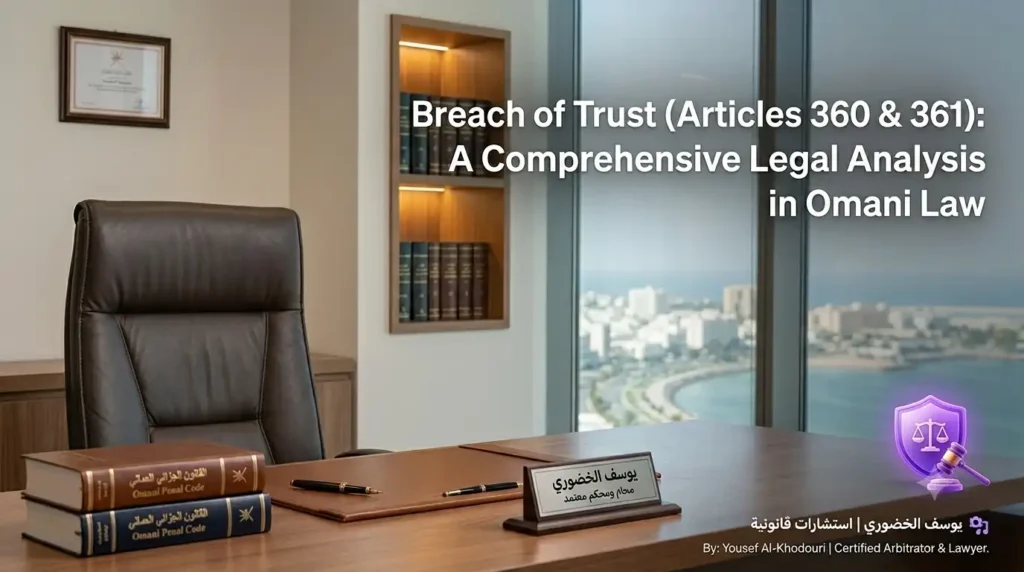
Breach of Trust in Omani Law Analysis by Lawyer Yousef Al-Khodouri

Breach of Trust: A Comprehensive Legal Analysis of Articles (360) and (361) of the Omani Penal Code

Introduction Trust is the cornerstone of modern commerce and personal relationships. When this trust is betrayed, specifically regarding financial assets and movable property, the law must intervene to restore order and ensure justice. The Omani legislator, through the Penal Code issued by Royal Decree No. 7/2018, has established a robust framework to combat the crime of breach of trust. This crime represents a significant threat to financial stability, and its legal treatment requires a meticulous understanding of the relationship between the parties. This article provides a deep dive into the elements of breach of trust under the Omani legal system, focusing on the distinct legal provisions of Article (360) and Article (361). The Traditional Breach of Trust: Article (360) Article (360) serves as the primary legislative pillar for breach of trust in Oman. It targets cases where an individual is entrusted with specific property based on a prior contractual relationship. The essence of this crime lies in the violation of the confidence placed in the perpetrator by the owner. The Fiduciary Relationship: The law specifies contracts such as bailment, agency, lease, and mortgage. However, the inclusion of the phrase “or was entrusted with it in any way whatsoever” serves as a crucial legal mechanism for the expansion of the law’s protective scope. This expansion ensures that any legal arrangement creating a fiduciary obligation—regardless of its technical name—falls under the jurisdiction of Article (360). The Material Elements: For a conviction to stand, the prosecution must prove two main components: the lawful handover of the property (possession) and the subsequent act of betrayal. The betrayal is manifested through actions such as concealment, denial, embezzlement, dissipation, or total destruction of the entrusted asset. The Subjective Intent (Mens Rea): The perpetrator must possess the general criminal intent, knowing that the property belongs to another and that their actions are contrary to the owner’s rights. Negligence or accidental loss does not constitute a criminal breach under this article. The Crime of Misappropriating Lost Property: Article (361) While Article (360) governs trust born from a contract, Article (361) addresses a different scenario: the misappropriation of lost property. This crime is distinct because there is no prior contractual “handover” of the asset. The Nature of the Possession: In this instance, the perpetrator acquires the property by chance—by finding it after it has been lost by its owner. The legal obligation arises not from a contract, but from the moral and legal duty to return the property to its rightful owner. The Act of Misappropriation: The crime occurs when the finder, despite knowing or being able to ascertain the identity of the owner, refuses to return the asset. This refusal is the active element that transforms a mere finding of property into a punishable offense. Comparative Gravity: The penalties stipulated in Article (361) are generally more lenient than those in Article (360). This legislative choice reflects the lower degree of betrayal, as the perpetrator in Article (361) has not violated a pre-existing professional or contractual bond. Procedural Considerations and Judicial Trends Proving breach of trust in Omani courts is a complex task. The burden of proof lies heavily on the complainant to demonstrate not only the loss of the asset but also the existence of the entrustment relationship. Judicial precedents from the Supreme Court of Oman emphasize that without clear evidence of a valid contract or an explicit “fiduciary hold,” the dispute may be dismissed as a civil matter rather than a criminal one. Legal practitioners must focus on building a robust evidentiary foundation, including written agreements, electronic correspondence, and witness testimonies. Furthermore, in cases involving corporations, the application of these articles often intersects with issues of corporate liability and the scope of social responsibility. Understanding the nuances of “entrustment” vs. “ownership” is often the decisive factor in whether a defendant is acquitted or convicted. “For further reference on the judiciary’s structure, please visit the official portal of the Supreme Judicial Council.“ “While Article (176) guarantees the procedural integrity required for a fair trial—essential for establishing liability—the subsequent assessment of damages is addressed in our in-depth study. For a detailed guide on recovery and compensation, see: Legal Compensation: A Comprehensive Guide to Liability and Redress. “Know your rights, demand fairness. Explore the complete guide to Oman’s Consumer Protection Law here.”   Conclusion The Omani Penal Code, through Articles (360) and (361), provides a comprehensive shield against the exploitation of trust. By providing the legal infrastructure to handle both contractual breaches and the misappropriation of lost goods, the legislator ensures that trust—the essential element of society—is legally protected. For individuals and businesses alike, the key to safety lies in the meticulous documentation of all transactions and a thorough understanding of these statutory provisions. Ensuring that every asset handover is backed by a legally sound agreement is the ultimate strategy for avoiding the pitfalls of breach of trust and safeguarding one’s legal rights before the courts.  

Breach of Trust: A Comprehensive Legal Analysis of Articles (360) and (361) of the Omani Penal Code Read More »

Oman Labor Rights: Legal Insight into Articles 4, 5, and 6

The Omani Labor Law serves as the cornerstone of employment relations within the Sultanate, meticulously outlining the rights and obligations of both employers and employees. Its overarching aim is to foster a balanced and equitable work environment, ensuring the dignity and fair treatment of the workforce. Among its crucial provisions, Articles 4, 5, and 6 stand out as fundamental pillars safeguarding employee interests. This comprehensive analysis delves deeper into these articles, examining their nuances, legal ramifications, and practical implications within the Omani employment landscape. Article 4: The Imperative of Legal Supremacy and the Preservation of Superior Employee Benefits Article 4 of the Omani Labor Law establishes a clear hierarchy, asserting the primacy of the law’s provisions over any conflicting agreements, regardless of their temporal precedence. This declaration of nullity for contravening conditions or agreements, unless they offer a more advantageous position for the employee, is a robust mechanism against potential contractual clauses designed to undermine statutory protections. The Principle of Lex Posterior Derogat Legi Priori and its Exception: The article implicitly addresses the legal principle of lex posterior derogat legi priori (a later law repeals an earlier law). However, it introduces a crucial exception rooted in the welfare of the employee. While generally, a newer law supersedes older ones, Article 4 carves out a space for pre-existing agreements to remain valid if, and only if, they bestow greater benefits upon the worker. This exception underscores the legislator’s intent to ensure that the evolution of labor law serves to progressively enhance, rather than diminish, employee rights. The Invalidation of Waivers, Settlements, and Relinquishments: The second part of Article 4 extends this protective umbrella to encompass any attempt by an employee to waive, settle, or relinquish rights stemming from the Labor Law if such an action contradicts its provisions. This is a critical safeguard against situations where employees, potentially facing economic duress or undue influence, might be coerced into forfeiting their legally mandated entitlements. The law recognizes the inherent power imbalance that can exist in the employer-employee relationship and acts to mitigate the risk of exploitation through such waivers. The Perpetuation of Superior Existing Benefits: The concluding segment of Article 4 ensures the continuity of any superior benefits that employees were entitled to under pre-existing laws, regulations, or decisions at the time the current Labor Law came into effect. This “standstill” provision prevents the new law from inadvertently diminishing advantages already enjoyed by workers. It promotes a principle of continuous improvement in labor standards, where existing favorable conditions are preserved as a baseline. Illustrative Legal Scenarios and Implications Scenario 1: Retroactive Application and Conflicting Contracts: Imagine an employment contract signed before the enactment of the current Labor Law stipulated a reduced notice period for termination compared to what the new law mandates. Article 4 would render this clause invalid, and the employee would be entitled to the longer notice period prescribed by the current legislation, as the prior agreement is less beneficial. Scenario 2: Coerced Waiver of End-of-Service Benefits: An employee, upon termination, is pressured by the employer to sign a settlement agreement accepting a significantly lower amount than their statutory end-of-service gratuity. Article 4 would deem this settlement void, and the employee would retain the right to claim the full amount as per the Labor Law. Scenario 3: Preservation of Existing Bonus Schemes: A company, prior to the current Labor Law, had a generous annual bonus scheme exceeding what might be minimally required under the new regulations. Article 4 ensures that this more favorable bonus scheme continues to apply to the employees. Article 5: The Unwavering Prohibition of Forced and Compulsory Labor – Upholding Human Dignity Article 5 of the Omani Labor Law stands as an emphatic declaration against all forms of forced or compulsory labor. This prohibition is not merely a legal stipulation within the national context but resonates deeply with international human rights conventions and core labor standards established by organizations like the International Labour Organization (ILO). Defining Forced and Compulsory Labor: Forced or compulsory labor, as understood in international law and as implied by Article 5, encompasses any work or service which is exacted from a person under the menace of any penalty and for which the person has not offered themselves voluntarily. This definition extends beyond physical coercion to include psychological duress, economic pressure, and the withholding of essential documents. The Significance of Voluntariness and Consent: The cornerstone of Article 5 is the principle of free and informed consent in the employment relationship. Employees must enter into and continue their employment willingly, without any form of coercion or compulsion. This ensures that work is performed as a result of a mutual agreement and not under duress. Implications for Employer Practices: Article 5 places a significant obligation on employers to ensure that all work performed by their employees is voluntary. This means that employers cannot: Link to Human Trafficking and Exploitation: Article 5 also serves as a crucial legal instrument in combating human trafficking and other forms of severe labor exploitation. By explicitly prohibiting forced labor, the law provides a basis for prosecuting individuals and entities involved in such practices. Article 6: Safeguarding Employee Autonomy Through Restrictions on Document Retention Article 6 of the Omani Labor Law addresses a particularly sensitive aspect of the employment relationship: the employer’s possession of an employee’s personal documents, specifically their passport or private papers. The article establishes a clear restriction, prohibiting employers from retaining these documents without the explicit written consent of the employee. Rationale Behind the Restriction: The rationale behind this provision is to protect employees from potential abuse and to ensure their freedom of movement and personal autonomy. The retention of an employee’s passport by the employer can create a situation of dependency and control, making it difficult for the employee to leave their employment or exercise their rights freely. The Requirement of Written Consent: The exception to this prohibition is the explicit written consent of the employee. This requirement underscores the voluntary nature of such an arrangement. The

Oman Labor Rights: Legal Insight into Articles 4, 5, and 6 Read More »

Legality and Innocence in Omani Criminal Justice

Introduction: The Omani Penal Code, like many modern legal systems, rests upon fundamental principles that safeguard individual liberties and ensure a fair and just criminal process. Among these cornerstones are the tenets articulated in Articles 3, 4, and 5. These articles, though concise, encapsulate profound legal concepts that shape the very fabric of criminal jurisprudence in the Sultanate of Oman. This article delves into the significance of these provisions, exploring their meaning, implications, and their role in upholding the rule of law within the Omani legal framework. Article 3: The Principle of Legality (Nullum Crimen Nulla Poena Sine Lege) Article 3 of the Omani Penal Code unequivocally states: “No crime and no penalty except by virtue of law.” This provision embodies the fundamental principle of legality, often expressed by its Latin maxim nullum crimen, nulla poena sine lege – no crime and no punishment without law. This principle serves as a cornerstone of modern criminal justice systems around the world and functions as a critical safeguard against the arbitrary or retrospective application of criminal law. The principle of legality encompasses several key aspects: The principle of legality enshrined in Article 3 is vital for upholding the rule of law. It ensures that the power of the state to define and punish criminal behavior is exercised within clearly defined legal boundaries, thereby protecting individual freedoms and preventing abuse of power. Article 4: The Presumption of Innocence and the Right to Defense Article 4 of the Omani Penal Code articulates two fundamental rights of the accused: “The accused is innocent until proven guilty in a legal trial in which the necessary guarantees to exercise the right of defense are ensured in accordance with the law, and no person shall be held responsible for the crime of another.” This article embodies two core principles of criminal justice: the presumption of innocence and the principle of individual criminal responsibility. The Presumption of Innocence: The first part of Article 4 establishes the presumption of innocence, a cornerstone of fair trial principles in democratic societies. This principle dictates that every person accused of a crime is considered innocent until their guilt is proven beyond a reasonable doubt in a fair and impartial trial. The burden of proof rests entirely on the prosecution to establish the guilt of the accused, and the accused is not required to prove their innocence. The presumption of innocence has several crucial implications: Individual Criminal Responsibility: The final clause of Article 4 of the Omani Penal Code, “and no person shall be held responsible for the crime of another,” enshrines the principle of individual criminal responsibility. This fundamental tenet of criminal law dictates that criminal liability is personal and cannot be attributed to others merely due to their association or relationship with the offender. Each individual is held accountable solely for their own actions and their own culpable mental state (mens rea). This principle serves to prevent collective punishment and ensures that only those who personally engage in criminal conduct are subject to legal sanctions. Article 5: The Obligation of Legal Knowledge Article 5 of the Omani Penal Code states: “Ignorance of the law is not an excuse.” This legal principle, commonly expressed in Latin as ignorantia juris non excusat or ignorantia legis neminem excusat, is a foundational concept in criminal and civil law. It is a practical necessity for the effective functioning of any legal system, including the Omani legal framework. The rationale behind this principle is multifaceted. First, it promotes legal certainty by holding individuals responsible for knowing the law within the jurisdiction they reside in or operate under. Second, it prevents false claims of ignorance from undermining the rule of law. Third, it encourages public awareness and responsibility, ensuring that all members of society are treated equally under the Omani Penal Code. The rationale behind this principle is multifaceted: It is important to note that while ignorance of the law itself is not a defense, the existence of a genuine and reasonable mistake of fact may, in certain circumstances, negate the criminal intent required for some offenses. For example, if a person unknowingly possesses a prohibited item believing it to be something else entirely, this mistake of fact might be a valid defense. However, ignorance of the law prohibiting the possession of such an item would not be. Conclusion: Articles 3, 4, and 5 of the Omani Penal Code lay a robust foundation for a fair and just criminal justice system. Article 3, embodying the principle of legality, ensures that criminal offenses and penalties are clearly defined in law, preventing arbitrary or retrospective application. Article 4 safeguards the fundamental rights of the accused through the presumption of innocence and the guarantee of a comprehensive right to defense, while also upholding the principle of individual criminal responsibility. Finally, Article 5 establishes the necessary principle that ignorance of the law is not an excuse, promoting legal awareness and ensuring the effective enforcement of legal norms. These three articles, working in concert, underscore Oman’s commitment to the rule of law and the protection of individual rights within its criminal justice framework. They serve as enduring pillars upon which a fair and equitable system of justice is built and maintained. ✍️ Written by: Attorney Yousuf Al-KhudhoriOmani Lawyer & Legal Consultant https://law-yuosif.com/en/legal-services-in-oman-for-english-speakers/ https://qanoon.om/p/2018/rd2018007/ https://linktr.ee/LawyerYusuf

Legality and Innocence in Omani Criminal Justice Read More »